

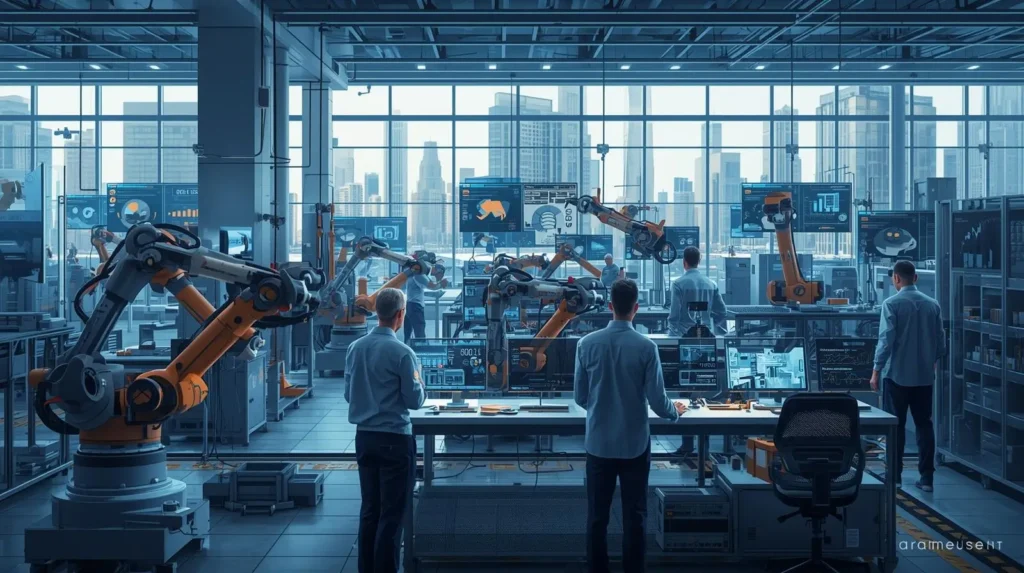
Smart Manufacturing GCC | Industry 4.0 UAE | AI Predictive Maintenance
The Middle East’s Industrial Revolution 4.0 Has Arrived
From oil fields to advanced robotics, the Middle East is fast becoming one of the world’s most promising industrial innovation hubs.
Driven by national visions like Saudi Vision 2030 and the UAE’s Industry 4.0 Strategy, the region’s manufacturing sector is evolving into a digitally intelligent ecosystem, where Artificial Intelligence (AI), IoT, and data analytics are transforming every process — from production to delivery.
AI is no longer a futuristic concept; it’s now the core of smart manufacturing — enabling predictive maintenance, automated quality control, and optimized supply chains. By 2025, AI-driven factories across the GCC will be setting new global benchmarks in productivity, efficiency, and sustainability.
According to Frost & Sullivan, the Middle East’s smart manufacturing market is projected to exceed $10 billion by 2027, led by major industrial hubs in the UAE and Saudi Arabia.
What Exactly Is Smart Manufacturing — and Why It Matters Now
Smart manufacturing, often referred to as Industry 4.0, integrates AI, robotics, IoT sensors, and machine learning into traditional factory environments. The result? Factories that can think, predict, and self-optimize.
In the GCC, where industrial diversification is a key economic goal, smart manufacturing is transforming how factories operate by:
- Predicting equipment failures before they occur,
- Automating repetitive processes,
- Reducing human error, and
A 2024 PwC GCC survey found that manufacturers adopting smart factory technologies achieved an average 20% increase in productivity and a 30% reduction in operational downtime within the first year.
The UAE’s Operation 300bn and Saudi Arabia’s National Industrial Strategy are clear indicators: the future of Middle Eastern manufacturing is intelligent, data-driven, and fully automated.
AI-Powered Predictive Maintenance: The Heart of Smart Factories
One of the most transformative applications of AI in manufacturing is predictive maintenance — a system where machines tell you when they’re about to fail, not after they break.
Using IoT sensors and AI analytics, manufacturers can continuously monitor equipment performance and detect early warning signs like temperature fluctuations, vibration patterns, or voltage irregularities.
Benefits of Predictive Maintenance:
- Reduces unplanned downtime by up to 50%
- Cuts maintenance costs by 30–40%
- Extends machine lifespan and improves reliability
Example:
A Riyadh-based automotive components plant integrated an AI-powered predictive maintenance system that analyzed motor vibration data. The system detected potential bearing failures weeks before they occurred — saving the company nearly $1.2 million in annual production losses.
Predictive maintenance is not just an operational improvement; it’s a strategic necessity for GCC industries striving to compete globally.
AI-Driven Quality Control: Precision at Scale
In traditional manufacturing, quality inspection relies on human observation — slow, subjective, and prone to error. AI changes that.
Using computer vision and machine learning, AI can inspect products at the speed of production — detecting even microscopic defects invisible to the human eye.
How It Works:
- AI cameras scan products in real time.
- Deep learning models identify defects, irregular shapes, or packaging inconsistencies
- The system automatically separates non-compliant units, maintaining consistent quality.
Real-World Impact:
- AI inspection improves defect detection rates by 90–95%.
- Manufacturers reduce waste and rework costs by up to 40%.
Example:
A UAE-based packaging manufacturer using computer vision achieved 82% fewer manual errors and improved output quality across its 24/7 production line.
In an industry where consistency equals credibility, AI-based quality control ensures every product meets international standards — without slowing production.
Automation and Robotics: The Next Frontier of GCC Factories
AI doesn’t just optimize existing processes — it enables full autonomous automation. By integrating AI with robotics, GCC factories are now capable of automating everything from material handling to assembly line optimization.
Examples of AI Automation in Action:
- Robotic arms powered by AI can learn from human movements and replicate tasks more accurately.
- Automated Guided Vehicles (AGVs) navigate factory floors intelligently, transporting materials based on real-time workflow priorities.
AI scheduling engines optimize manpower allocation and shift patterns.
Result:
Factories achieve faster output, consistent performance, and reduced operational costs — a vital competitive edge for the GCC’s rapidly expanding industrial base.
Siemens UAE reports that factories integrating AI-driven automation experienced up to 25% higher output efficiency and 20% lower energy consumption within the first year.
Supply Chain Optimization Through Predictive Analytics
Smart factories don’t stop at production — they extend intelligence across the entire supply chain.
AI enables manufacturers to forecast demand, automate procurement, and monitor supplier performance with precision.
How AI Strengthens Supply Chains:
- Predicts material demand to avoid overstocking or shortages.
- Identifies supplier risks and delivery delays early.
- Analyzes logistics data to optimize transportation routes and schedules.
Insight:
Saudi and UAE manufacturers using AI-based supply chain tools report 20–30% faster delivery times and improved customer satisfaction through data-driven operations.
When AI meets logistics, manufacturing becomes a connected ecosystem — where every decision, from production to shipping, is predictive and optimized.
Sustainability: AI’s Role in Green Manufacturing
As GCC nations lead global sustainability initiatives, AI is becoming an enabler of eco-efficient manufacturing.
AI Supports Sustainability By:
- Monitoring energy consumption across machines.
- Predicting optimal load balancing for reduced waste.
- Tracking carbon footprint and emissions in real time.
- Automating waste sorting and recycling processes.
The UAE’s Ministry of Industry and Advanced Technology reports that AI-driven energy optimization has reduced industrial power waste by up to 35% in select pilot factories.
By combining AI insights with sustainability goals, GCC manufacturers can lower costs and comply with global environmental standards — while strengthening their brand reputation as ethical, future-ready enterprises.
Government Initiatives Fueling AI Adoption
No other region is investing in industrial AI transformation as aggressively as the GCC.
UAE – Industry 4.0 Strategy
- Targets 200+ smart factory upgrades by 2031.
- Focus on AI, robotics, additive manufacturing, and digital twins.
Saudi Arabia – National Industrial Strategy
- Aims to build 36,000 factories by 2035, many powered by AI and automation.
- Launch of the “Future Factories Program” to assess and modernize production facilities.
Qatar & Oman – Smart Manufacturing Vision
- Driving AI adoption for sustainability and supply chain resilience.
These initiatives are supported by billions in funding, global partnerships, and workforce development programs — making the GCC one of the world’s most exciting markets for AI-driven industrial growth.
Challenges and How to Overcome Them
While the benefits are clear, AI integration in manufacturing does come with hurdles.
Key Challenges:
- High implementation costs for small and mid-sized manufacturers.
- Shortage of AI-skilled professionals in industrial engineering.
- Integration issues with legacy systems and machinery.
Solutions:
- Adopt phased AI implementation — starting with predictive maintenance, then scaling to full automation.
- Partner with specialized AI firms like ShichifukuTekx FZE, which tailor solutions for GCC compliance and cultural contexts.
- Invest in hybrid cloud systems to balance cost and scalability.
The key to AI success in manufacturing lies not in massive transformation overnight — but in gradual, data-driven integration that delivers measurable ROI.
The ShichifukuTekx FZE Advantage: Leading AI-Driven Manufacturing Transformation
At ShichifukuTekx FZE, we help manufacturers across the Middle East embrace the power of AI — intelligently, securely, and profitably.
Our Smart Manufacturing Solutions Include:
- AI-powered predictive maintenance systems
- Computer vision for automated quality inspection
- IoT + AI integration for real-time analytics
- Supply chain automation and predictive logistics
- Sustainability optimization through intelligent energy tracking
Why Middle Eastern Manufacturers Choose Us:
- Deep expertise in Industry 4.0 transformation
- Proven results across automotive, logistics, and industrial sectors
- Arabic-English AI interface design for local adaptability
- Compliance with ISO 27001 and GCC industrial standards
We don’t just implement AI — we build intelligent ecosystems that drive measurable business performance.
Conclusion
The Future of Manufacturing Is Smarter – and It’s Happening Now
The Middle East’s manufacturing sector is not catching up — it’s leapfrogging.
With AI as its engine, the region is moving from manual processes to self-learning factories, capable of producing more with less — less waste, less downtime, and less risk.
By 2030, GCC industries won’t just compete globally; they’ll lead it — powered by AI-driven intelligence, automation, and sustainability.
At ShichifukuTekx FZE, we’re proud to help manufacturers make that leap — turning today’s factories into tomorrow’s smart enterprises.
The future of Middle Eastern manufacturing isn’t just automated — it’s intelligent, predictive, and unstoppable.